Monday, July 16, 2018

Us Against You – A Middling Follow-Up to the Brilliant “Beartown”


“….he learns that people will always choose a simple lie over a complicated truth, because the lie has one unbeatable advantage: the truth always has to stick to what actually happened, whereas the lie just has to be easy to believe…”


What’s so great about a Fredrik Backman novel? He delivers elegant, unparalleled insights on the fragility and strengths of human nature. That’s all.

Of course, the Swedish novelist isn’t saying anything perfectly original on this topic that philosophers, anthropologists, scientists, and artists haven’t said throughout centuries of human history. Yet the way Backman packages the truths about human condition through well-drawn, three-dimensional characters and poignant narrative evokes a kind of frenzy within the reader to finish his book ASAP. Us Against You [Beartown #2] , the sequel to the author’s much acclaimed ‘Beartown’, is no different. It has all the ebbs and flows of a good fiction. There’s also a third book in works to form the ‘Beartown trilogy’. The first question before starting up Us Against You that plagued me is, ‘why there’s a need for a sequel?’ Backman pretty much resolves most of the huge conflicts brought forth in ‘Beartown’, and even provides glowing forecast regarding our favorite characters’ future. But of course, I was not going to pass off the chance to keenly observe this fictional community, whose caustic as well as estimable qualities holds a mirror to the modern human existence.

‘Us Against You’ starts off from the summer with star-hockey player Kevin Erdahl (who raped the ice hockey team general manager Peter Andersson’s daughter Maya) moving away from the fictitious Swedish backwoods town Beartown. Maya is still vilified for saying the truth about Kevin in public (“the idiots won’t say it was Kevin who killed Beartown ice hockey; they’ll say that ‘the scandal’ killed the club.” laments Maya). Although this isolated town had lost its jobs and investments, it had a strong sense of community thanks to the hockey rink. Now the townspeople are divided over 'the scandal’. Most of the hockey players have moved to Hed hockey, Beartown’s rival team. Beartown hockey has also lost its funding and the town council has decided to only support Hed. Peter’s wilful and beloved wife Kira Andersson sees a silver-lining in the club’s decision. She thinks that it’s time to move on and take steps to achieve her career dreams.

Their family unit, however, has taken a heavy damage. Peter and Kira’s relationship is in shambles. Maya tries her best to suppress the traumatic memories with the help of her oddball best-friend Ana, but it hasn’t been easy. Twelve-year-old Leo, Peter & Kira’s youngest son, feels alone like any kid on the cusp of adolescence, although what happened to his sister has kindled a violent impulse within him. Soon, the town gets its savior, who is actually a corrupted and manipulative politician. Richard Theo, the isolated political figure in Beartown, tries to revive the town’s ice-hockey prospects and jobs. Even though the intentions seem good, Theo’s primary aim is to gain political power and oust his rivals. Hence he conceives an elaborate, sinister plan that once again sets in motion the hate, anxiety, and violent disputes. Beartown also gets a new hockey coach with no-frills attitude, Elizabeth Zackell. Her alleged homosexuality and utter lack of sense of humor raises concern in certain quarters. But all she wants to be is a hockey coach (not ‘female’ hockey coach). Two additional characters are thrown into the mix: Teemu Rinnius, the unheralded leader of the ardent hockey fans (known as ‘The Pack’ and ‘hooligans’); and his madcap younger brother Vidar Rinnius who happens to be the team’s best goal-keeper, now serving a sentence at a psychiatry institute. Benji, the brawny 18-year-old who stood up against his best friend Kevin, continues to wrestle with his gay identity. Similar to ‘Beartown’, Backman opens the tale by saying what the cumulative force of hate is going to achieve in the end: a death. Naturally, it makes us dig through the pages and wait with bated breath to find out which one of our beloved characters’ life is in threat.

‘Us Against You’ lacks the dense, organic plotting of 'Beartown' and the author’s other novels. But Backman’s storytelling technique retains the page-turning qualities, consistently tickling, hurting, jabbing us with the narrative developments. Us Against You is written to be read as a stand-alone novel, so for the first few pages the writer repeats the gist and feelings of what happened earlier. This is a minor distraction. And it would be wholly fruitless to read the sequel first without going through the flagship work. In Backman’s universe, like in ours, there are no pure evils and pure goodness. People and their actions always occupy the grey territory. So once again Backman makes good people take bad decisions and gives space for the bad ones to nurture humane gestures. Maya, Kira, Ramona, Jeannette, Adri, the story gives us array of strong female characters who often stands as the forces dispelling the climate of ill-will. As I mentioned earlier the voice of Backman is lyrical and insightful. However, the conflicts he introduces and the characterizations aren’t much interesting as it was in ‘Beartown’.

Much of the problem is that Us Against You doesn’t have a centralized plot. It boasts far too many narrative threads which lead to bit of a stale, vignettes-type of storytelling. There was no moment when there’s a feeling that everything came together. Frankly, I was not interested in Richard Theo’s political manipulations, which is too convoluted and implausible to make us eventually care. Well-established characters like Peter, Kira, and Amat sleep-walks throughout the novel, the latter’s name being reduced to few mentions. Zackell is charming enough but nowhere as interesting as coach David (David is also cast to the periphery in this story). Teemu Rinnius and his Pack’s conflict with Peter don’t bring much tension as we expected. Teemu itself looks like a slightly older copy of Benji with a too simple emotional core. Vidar is introduced far too late into the story and his love story, created for the sake of making the ending ‘heart-breaking’, is cloyingly melodramatic. The fascinating portions in the novel involve Maya, Benji, Leo, and William Lyt. Especially, Lyt’s trajectory was unexpected but touching. ‘Beartown’ had some description of the team’s on-field games. Here the details are fleeting.

Fredrik Backman pursues his favorite thematic strands: hardships of parenting, misfortunes of adolescence, beliefs in tribalism, group hysteria, etc. His razor-sharp perceptions on greed, self control, sexuality, culture, ambition, dreams, etc are once again thoughtful and quote-worthy [“Sometimes good people do terrible things in the belief that they’re trying to protect what they love”, “When guys are scared of dark, they’re scared of ghosts and monsters, but when girls are scared of the dark, they’re scared of guys”, “Our spontaneous reactions are rarely our proudest moments”, “The worst thing we know about other people is that we're dependent on them. That their actions affect our lives. Not just the people we choose, the people we like, but all the rest of them: the idiots”]. The author’s wisdom keeps flowing which makes the novel’s emotionally manipulative turns less irritating. Subsequently, it would be nice if the author tone-down a bit with his faux-foreshadowing and overly bright character forecasts; it’s starting to get too repetitive. Altogether, this sequel to Beartown isn’t entirely necessary, but all the same it’s compulsively readable. 


Monday, July 9, 2018

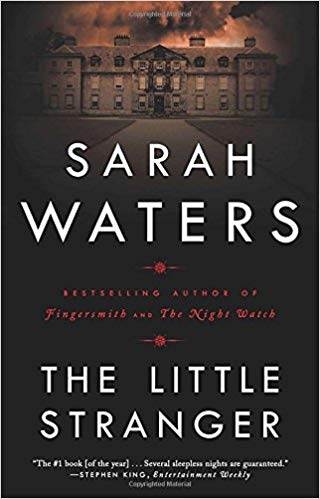
The Little Stranger – A Gripping Slow-Burn Psychological Mystery


“The sexual impulse is the darkest of all, and has to emerge somewhere. It’s like an electric current; it has a tendency, you know, to finds its own conductors. But if it goes untapped – well, then it’s a rather dangerous energy.”


I read British novelist Sarah Waters’ fifth novel The Little Stranger (published in 2009) based on a misconception. What I wanted to read was a spooky ghost story and Waters’ book was labeled as ‘ghost & horror fiction’. It was wrong on both counts. The Little Stranger didn’t frighten me, pushing my mind to conjure a spectral figure in the dark. Yet I was thoroughly intrigued by the author’s strangely affecting slow-burn storytelling, credible characters, and profound social set-up that the novel ‘haunted’ me for few days. Previously I got acquainted with Waters’ consummate prose while reading her dark twisted novel ‘Fingersmith’ (after seeing Park Chan-wook’s excellent movie adaptation ‘The Handmaiden’). The Little Stranger was similarly psychologically layered and class resentment or class anxiety once again plays a pivotal role in setting the rich characters.

The Little Stranger boasts all the Gothic motifs of the classic stories, ‘The Turn of the Screw’ (Henry James) and ‘The Haunting of Hill House’ (Shirley Jackson): a huge, spooky and crumbling manor with a dreadful past, the stranger noises and bloody accidents alleged to be the work of a ghostly pestilence, a well-bred young woman, and a skeptical man of science. However, Sarah Waters uses these familiar elements to intrigue us on surface level, while gradually and boldly infusing wholly different layers of tumultuous emotions beneath it, which eventually comes across as a smart reconstruction of the Gothic literature themes. The novel is set in a rapidly transforming post-World War II England, where social hierarchies are shaken up by the new Labour government. The country hasn’t still escaped the shadow cast by the prolonged period of war. It’s not just the common populace facing the torment of rationed food supplies, the once-wealthy owners of sprawling housing estates are also struck by the weak and recovering economy.

The Ayres Family of Hundreds Hall is one such family, ravaged by the uncertain times. The freshly emerging working classes are bringing about a change in the social system that indirectly affects the landed gentries. In those high-tax times, Warwickshire’s exquisitely beautiful 18th century mansion ‘Hundreds Hall’ is reduced to a grim structure encircled within thicket of weeds. Dr. Faraday, the middle-aged town doctor (and our narrator) well remembers his boyhood visit to the Hundreds, back in its glory days. He warmly recollects the day he paid visit to the Hundreds’ basement kitchen and partly glimpsed the estate’s marvel. Faraday’s mother was a former Hundreds housemaid and his father was a local shopkeeper. They had both sacrificed their lives for the sake of his medical degree. Dr. Faraday doesn’t have a family of his own, but relishes at the chance to serve the townspeople through his distinguished profession. One fine day in 1947, the doctor gets a call to treat an ailing servant of Hundreds. As soon as entering the estate, he finds that the 14-year-old servant girl isn’t ill, but simply frustrated and terrified by the place’s imposing, intimidating nature. The doctor discreetly addresses the girl’s anxiety. And to his surprise, he is invited to tea by Mrs. Ayres.

Sarah Waters

Initially upon entering into the house, Faraday meets the master of the house, Roderick Ayers. Though a young man in his early 20s, Roderick is worn-out by his wartime experience; a plane crash has awarded him with a burned face, hands, and an impaired knee. His older 26-year-old sister Caroline Ayers however displays boundless energy. Caroline is described as ‘plain-faced’ and a woman with ‘masculine features and unshaven legs’. Caroline’s physical features combined with her eccentric nature has nearly rendered her unmarriageable within their own class, since a girl’s duty in the gentry families is to be ‘proper’ and ‘dazzling’ so as to safeguard their property through a perfect alliance. She cavorts through the isolated mansion and surrounding areas, accompanied by her beloved dog Gyp. Nevertheless, Caroline’s marriage isn’t the only turbulent problem faced by the Ayreses. The family is sustaining on the meager income from the dairy farm. Acre by acre and farm by farm, the Ayreses are giving away the estate’s finer possessions. Most of the valuables within the estate are also sold. Still they have to spend a fortune to keep the structure upright, to mend the pipes, and keep the ever-peeling wallpapers intact. The old Mrs. Ayres’ has had her share of forlornness long before the war, ever since she lost her first daughter Susan (to diphtheria at the age of 6).

Dr. Faraday has known the Ayres family history and now observes firsthand their gradual descent. He is sympathetic towards their plight, but the bachelor doctor is also bothered by his “faintest stirrings of a dark dislike” whenever the Ayreses involuntarily display their old entitled status. Over the next few months, Faraday forges a friendship of sorts with the family, especially the sprightly Caroline. Alongside these rather mundane developments, there’s a strain of unease within Hundreds, supposed to have been caused by a mysterious force. After one particularly horrific incident, the unnerved young maid says, “There’s a bad thing in this house, that’s what! There’s a bad thing, and he makes wicked things happen!” The doctor believes that the ‘bad thing’ or wrongness associated to the old mansion must have a grounded, rational reason. But soon the restless and over-worked Roderick starts to see and feel inexplicable ‘things’, which sets off a madness that threatens to overpower the already bereaved family.

Spoilers Ahead….

Sarah Waters is best known for her historical fiction, set in Victorian-era England and often contains unflinching lesbian protagonists. The Little Stranger differs from those set-ups as it is set in the postwar period and doesn’t have any overtly lesbian characters. However, repressed sexuality and class dynamics play a major role. The author's prose is notable for restraint. It shows in the four characters she has created – 3 Ayres family members and the doctor – who all remain ambiguous throughout the end, never taking the easily identifiable position of good and evil. Waters spends good time (at least 100 out of the 512 pages) to establish the characters, their desires, conflicted emotions, and demoralizing thoughts. She also immerses us into the dilapidated yet strangely enchanting atmosphere of Hundreds – a vestige of the old British class system. Only one-fourth into the novel the ‘bad thing’ is mentioned. Still, the madness perpetrated by the alleged poltergeists isn’t amped-up like in a Stephen King novel. The question over the origin of ‘shadow-creature’ is coated with ambiguity with Dr. Faraday persistently balking at the idea of any supernatural presence.  

Domnhall Gleeson and Ruth Wilson are playing Dr. Faraday & Caroline Ayers respectively in the upcoming movie adaptation (releasing 31st August this year)

An unreliable narrator is one of the fascinating literary devices. Many times it is used to merely conjure a trick for unsuspecting readers. Rarely, the unreliability of a narrator philosophically questions the human consciousness, which despite yielding to science and reason doesn’t entirely quell its darkest desires, prejudices and paranoia. I loved how Waters subtly hints at Dr. Faraday’s clouded perception. His observations may seem transparent and clear-cut, yet slowly we get the feeling that a lot of emotions are boiling beneath that placid surface. The novel might be utterly disappointing to those expecting a chilling tale of ghosts. But I wasn’t bothered by the lack of preternatural forces because Waters makes the ravenous impulses and cravings of the characters' consciousness and repressed emotions much more haunting. While Henry James’ classic ghost literature used Freudian ideas of sexual repression to explore female sexuality of the Victorian-era, Sarah Waters intrepidly reassigns it and offers a different take on the sexual and gender politics. Waters provides ample clues to from where the Hundreds Halls’ “bundle of projected repressions” originates. The cumulative force of these clues tardily gathers and heavily strikes us in the book’s plaintive and nuanced final passage. It’s a baleful reminder of how ‘the little stranger’ (or ‘miasma’, ‘dark germ’) could creep inside any heart, nurturing self-deluded sense of love, class anxiety, repressed sexuality, etc. Altogether, The Little Stranger is a deeply unsettling novel, brimming with psychological complexity and unnerving mood, which smartly reinterprets the Gothic horror novel tropes. 


Monday, July 2, 2018

The Outsider – A Thrilling Procedural with a Supernatural Twist


"Like measles, mumps, or rubella, tragedy was contagious. Unlike those diseases, there was no vaccine."


Most of Stephen King’s novels contain terrifying transgressions that defy logic and suggests supernatural influence. The Outsider (published 22 May 2018) is no different. It starts with an unsettling crime and the ensuing grounded investigation points out to a human perpetrator. But the meticulous interrogation of eye-witnesses and realization of forensic evidence is derailed by one simple fact: the alleged killer has a very strong alibi. If it is the novel of Japanese crime writer Keigo Higashino, the truth would lie within the bounds of earth and would be eventually uncovered by thorough deduction. But this being a King’s story, the truth lays beyond the realm of reality or mundanity, where shadowy shape-shifting things prowl and feed upon people’s fear and sorrow.

The Outsider initially doesn’t seem like a ‘monster horror’ fiction like his undeniably best work IT. In fact, the story-telling technique feels like a continuation of ‘Bill Hodges’ Trilogy – Mr. Mercedes, Finders Keepers, and End of Watch – which gave King his Edgar Award (by Mystery Writers of America). The Bill Hodges trilogy is largely crime/police procedural fiction with tinges of Gothic horror and occult forces. Similarly, The Outsider is also a blend of fantastical things – the product of King’s capricious imagination of his hey days – and crime fiction. More surprising is how a prominent character from ‘Bill Hodges’ world enters into this novel, making Outsider partly a sequel to that franchise. I felt that King doesn’t do a perfect job in balancing the different genres and the descent into supernatural territory isn’t definitely the author's scariest. Yet this is a compelling page-turner with a good share of unnerving moments which gently coerces us to finish the 550 plus pages in few sittings.

The novel is set in fictional midsize town of Flint City, Oklahoma State. A 11-year old boy Frank Peterson is found in a local park, brutally murdered and sexually defiled. However, it’s not a whodunit mystery, since eyewitnesses, fingerprints, and DNA evidence undoubtedly implicates the town’s high-school teacher and beloved Little League coach Terry Maitland. Detective Ralph Anderson, whose own teenage son was coached by Maitland, was enraged by the developments. Driven by an agenda to perfectly humiliate the alleged perpetrator, Anderson arrests Maitland during a baseball game, in front of Maitland’s wife, two daughters (10 & 12 yrs old), and 1,500 town residents. The news spread like a forest fire and thanks to media circus a frenzy of speculation is set off. Meanwhile, Terry Maitland himself is enraged by Anderson’s public show and claims innocence. To the detective’s dismay, Terry’s alibi is rock-solid. He was out of town with colleagues at the exact time the crime occurred (there’s even a YouTube video showing Terry at a conference). While Anderson and determined District Attorney William Samuels wrack their brains to figure out how one person could be in two places at the same time, the crime and arrest wrecks the town’s harmony. With more twists and turns in the investigation, it becomes clear that the solution lies outside the perception of reality.  

Stephen King’s antagonist might be an otherworldly Pennywise-like child-eater, but the atmosphere and characters’ mood are undeniably grounded in today’s fears. “People are blind to explanations that lie outside their perception of reality”, writes King, which not only alludes to the story’s preternatural things, but also hints at Trump’s America that’s possibly spinning out of control. King quotes Sherlock Holmes’ famous opinion: “Once you eliminate the impossible, what­ever remains, no matter how improbable, must be the truth”. The trouble of not seeing the truth plus the mention of a moral rot at the roots of societal structure once again kind of gleams with a sociopolitical message. King also takes his characters to dilapidated locations painted with a swastika or adorned with placards like “TRUMP MAKE AMERICA GREAT AGAIN.” The boogeyman, feeding upon sorrow and fear, could very well be the metaphorical monster for the turbulent times. However, these overt references mostly offer an interesting shade or a shiny exterior rather than being profound. In fact, once King delves into the hunt for literally unspeakable evil, the philosophical and sociopolitical or socioeconomic meditations are promptly expelled.

Of course, we don’t read King, seeking subtlety or strong social messages. We read him for those brilliantly conceived set pieces, where we pray for the well-drawn characters’ survival against the pure evil. King doesn’t disappoint us on that aspect as he swiftly plumbs into the gloomy depths without ever forgetting to imbue human sensitivity. Despite few letdowns and rough edges, King’s incessant references to pop-culture and literature provide lot of memorable moments. King’s wealth of references range from Poe’s short-story William Wilson, Agathe Christie, Conan Doyle, Shakespeare, Game of Thrones, Mexico’s Luchador movies, and even Stanley Kubrick (socially awkward Holly Gibney champions Paths of Glory, remarking that it is ‘better than the Shining’ and further adding, “but of course he [Kubrick] was much younger when he made it [Paths of Glory]. Young artists are much more likely to be risk-takers, in my opinion”). Part of the charm in reading King’s books rests in gorging upon these cultural references and so on. Overall, The Outsider doesn’t enchantingly reconstruct the prolific author’s formulas and tropes, but there’s enough intriguing elements in it to devour the book in one go.